

Choosing the right hair transplant technique is essential for achieving natural, long-lasting results. The three leading methods – FUE (Follicular Unit Extraction), FUT (Follicular Unit Transplantation), and DHI (Direct Hair Implantation) – each offer unique benefits and challenges. In this article, we’ll compare these popular procedures across crucial aspects such as operation time, recovery period, advantages, disadvantages, risks, and costs to help you make an informed decision.
Overview of Techniques
- FUE (Follicular Unit Extraction):
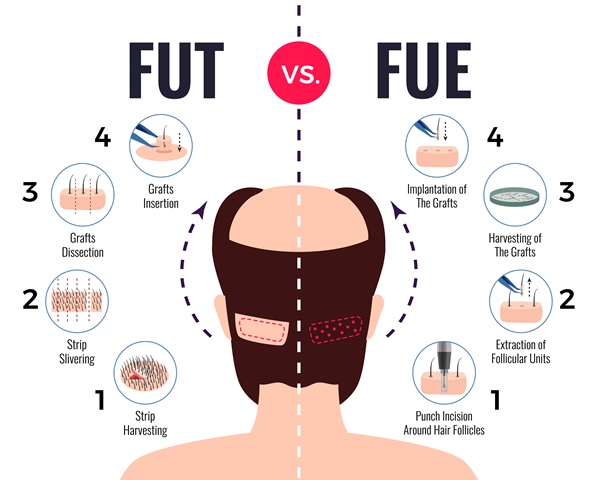
Individual hair follicles are extracted from the donor area and implanted into the recipient area. No linear scar is left behind. - FUT (Follicular Unit Transplantation):
A strip of scalp containing hair follicles is surgically removed and divided into grafts for transplantation. A linear scar is usually left on the donor area. - DHI (Direct Hair Implantation):
A modification of FUE using a Choi Implanter Pen that allows immediate implantation of hair follicles without pre-made channels.
FUE vs FUT vs DHI: Key Comparison Table
| Aspect | FUE | FUT | DHI |
|---|---|---|---|
| Invasiveness | Minimally invasive | More invasive | Minimally invasive |
| Scarring | Tiny dot scars | Linear scar | Tiny dot scars |
| Operation Length | 6-8 hours | 4-6 hours | 8-10 hours |
| Recovery Time | 7-10 days | 10-14 days | 7-10 days |
| Pain Level | Mild | Moderate | Mild |
| Hassle During Operation | Moderate | Low | High (due to precision) |
| Cost | Moderate | Lower | Higher |
| Graft Survival Rate | Moderate-High | Moderate | High |
| Ideal for Large Areas | Yes | Yes | Better for smaller areas |
| Customisation (Angle, Depth) | Good | Moderate | Excellent |
| Risk of Complications | Low | Moderate | Low |
FUE vs FUT vs DHI: Advantages and Disadvantages
FUE
One of the biggest advantages of FUE is that it leaves minimal visible scarring, making it ideal for patients who prefer to wear their hair short. Recovery time is faster compared to traditional strip methods, typically within a week to ten days. It also offers a natural look when performed by a skilled surgeon.
However, FUE can be time-consuming, especially for large areas requiring thousands of grafts. The donor area usually needs to be shaved, which some patients may find inconvenient. Additionally, if the extraction process is not done carefully, there is a risk of uneven hair density and poor aesthetic outcomes.
FUT
FUT is often praised for its efficiency in treating larger bald areas. Since it involves removing a strip of scalp rather than individual follicles, the procedure is generally quicker than FUE and may not require shaving the entire head. This makes it an appealing choice for patients who prioritize volume restoration at a lower cost.
On the downside, FUT does leave a permanent linear scar on the donor area, which can be visible if the hair is worn very short. Healing time is typically longer compared to FUE, and patients might experience greater discomfort during the recovery phase.
DHI
The main advantage of DHI is the high precision it offers during implantation. The use of a Choi Implanter Pen allows the surgeon to control the angle, depth, and direction of each hair, resulting in an extremely natural-looking hairline. DHI is also associated with higher graft survival rates since follicles are implanted immediately after extraction, minimizing their exposure.
However, DHI tends to be the most expensive option due to the complexity of the technique and the specialized equipment involved. Operations take longer and require an even higher level of surgeon skill, which may limit the number of clinics offering truly expert DHI procedures.
FUE vs FUT vs DHI: Risks and Complications
- FUE Risks: Overharvesting donor area, poor graft survival if improperly handled
- FUT Risks: Visible scarring, infection risk at incision site
- DHI Risks: Limited graft capacity per session, higher cost may lead to patient selection bias
Operation Length and Recovery
- FUE operations typically last 6–8 hours and need about 7–10 days for recovery.
- FUT procedures are slightly quicker (around 4–6 hours) but require 10–14 days for healing due to the surgical incision.
- DHI sessions can extend to 8–10 hours but allow quicker recovery similar to FUE within 7–10 days.
Cost Considerations
- FUT tends to be the most affordable option because it’s less time- and labor-intensive.
- FUE is moderately priced but can vary depending on the number of grafts.
- DHI is the most expensive method due to the specialized tools and greater precision required.
Which Method Is Best for You?
The best method depends on your needs:
- If you prioritize minimal scarring and natural looks ➔ Choose FUE or DHI.
- If you want maximum grafts at a lower cost ➔ FUT might be better.
- If you seek the most advanced, natural, and customized hairline ➔ DHI is the top choice, provided you are willing to invest more time and money.
Consulting with an experienced surgeon is crucial for determining the right technique based on your hair loss stage, donor area quality, and expectations.


Leave a Reply